
 Get the Muslim Alim app
Salat al-Janazah: how to perform the funeral prayer
1. Opening position
The funeral prayer is performed standing, in rows behind the imam. The body of the deceased is placed before the imam, at right angles to the qibla.
Form the intention to pray Salat al-Janazah for the deceased.

2. First takbir
Begin by raising your hands level with your ears, saying "Allahu Akbar".
Then recite Surah Al-Fatiha:
3. Second takbir
Say the second "Allahu Akbar", raising your hands.
Recite the prayer upon the Prophet (Salat al-Ibrahimiyyah):
4. Third takbir
After the third "Allahu Akbar", make sincere supplications for the deceased.
Here is the supplication for the deceased (for an adult):
5. Fourth takbir and the final greeting
Say the last "Allahu Akbar".
End the prayer with the taslim (salam) to the right only, saying "Assalamu alaykum wa rahmatullah".
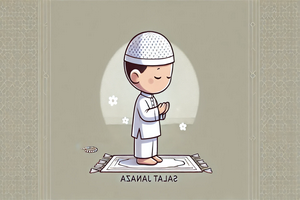
Important note: Salat al-Janazah has no bowing (ruku) and no prostration (sujud). It is performed standing throughout.
A complete guide to Salat al-Janazah according to the Islamic teachings
The funeral prayer or salat al-janazah is a communal obligation in Islam. It differs from the five daily prayers in several ways. This prayer is performed standing only, with no prostrations and no bowing.
Before beginning, those taking part must perform their ablutions as for any prayer. The imam stands level with the head of the deceased if a man, level with the middle of the body for a woman. The worshippers line up behind the imam in close rows.
Salat al-janazah has four takbirs. After the first "Allahu Akbar", Al-Fatiha is recited silently. The second takbir is followed by the prayer upon the Prophet Muhammad. At the third, supplications are made for the deceased and their family. The fourth takbir comes just before the final greeting.
This prayer must take place after the body has been washed and wrapped in a white shroud. It may not be held during the forbidden hours : at sunrise, at the zenith and at sunset. The best time falls between two of the five daily prayers.
The recommended supplications include asking forgiveness for the deceased, prayers that Allah ease their passage into the Hereafter, and supplications to comfort their family. If the deceased is a child, one prays that they be an intercession for their parents.
The prayer ends with the greeting to the right only. After the ceremony, the body is carried to the place of burial, where other **particular supplications** are recited.
Also worth reading
All of Prayer & worship
The Adhan and the Iqamah
Learn the Adhan and the Iqamah phrase by phrase: Arabic text, transliteration, English translation and audio, including the extra line of the Fajr call.
Read
Tawaf and Sa'i counter
Count your 7 circuits around the Kaaba and your 7 trips between Safa and Marwah without losing track. A free counter for Hajj and Umrah, with rite reminders.
Read
Digital dhikr counter
A free dhikr counter for reciting SubhanAllah, Alhamdulillah, Allahu Akbar, La ilaha illa Allah and Astaghfirullah, with a running total of your dhikr.
Read
Dua of the last 10 nights
The dua to recite during the last 10 nights of Ramadan and Laylat al-Qadr: Allahumma innaka Afuwwun, in Arabic, transliteration and English, with its source.
ReadDua for breaking the fast
The dua to recite at iftar: Dhahaba adh-dhama'u in Arabic, transliteration and English, its source in Abu Dawud, and the right moment to say it.
Read
Essential duas in Arabic and English
Over 30 authentic duas sorted by situation: morning and evening, sleep, meals, travel, protection, illness, study. Arabic text, transliteration and English.
ReadYou may be wondering…
How do I perform Salat al-Janazah?
The funeral prayer is performed standing, in rows behind the imam, with the deceased placed before him. It has four takbirs: after the first, Al-Fatiha is recited; after the second, the prayer upon the Prophet ﷺ (Allahumma salli ala Muhammad…); after the third, supplications for the deceased; after the fourth, the salam is given. The guide gives each text in Arabic, transliteration and English.
How many takbirs are there in the funeral prayer?
Salat al-Janazah has four takbirs (Allahu Akbar) according to the practice of most schools of law. Some Companions reported that the Prophet ﷺ sometimes said five, so some scholars allow that number, but four remains the norm followed in most mosques. The hands are raised at least at the first takbir; for the rest, the schools differ.
Which dua should be recited for the deceased?
After the third takbir, one calls upon Allah for the deceased, for instance: Allahumma ghfir li hayyina wa mayyitina wa shahidina wa gha'ibina… (O Allah, forgive our living and our dead, those present and those absent…). One may also say Allahumma ghfir lahu warhamhu (forgive him and have mercy on him). For a child, one asks that he be an intercession for his parents. See other duas on the site.
Is the funeral prayer obligatory?
Salat al-Janazah is a communal obligation (fard kifayah): if a group of Muslims performs it, the rest are relieved of it; if no one does, the whole community is at fault. It takes place after the body has been washed and shrouded, before burial, and preferably outside the times when prayer is discouraged (sunrise, zenith and sunset). Taking part in it carries a great reward.
Are there prostrations in Salat al-Janazah?
No. The funeral prayer is performed entirely standing: it has no bowing (ruku), no prostration (sujud) and no sitting. It ends with the salam: a single salam to the right according to the Hanbali school and some scholars, or two salams (right then left) according to others. Ablutions are still required, as for the five daily prayers.