Get the Muslim Alim app
A complete guide to the Umrah: stages, rites and supplications
The essential stages and their supplications
If you have not yet done so, make sure you:
- Cut your finger and toe nails.
- Remove underarm hair.
- Remove pubic hair.
- Trim the moustache.
You should then perform the ghusl (full ablution), an act strongly recommended for anyone intending to enter ihram.
Salah al-Ihram
Entering the state of consecration at the miqat.
The Sunnah is to perform two rakahs of salah before entering the state of ihram.
This prayer may be performed after changing at the airport, or on the plane before crossing the miqat, provided there are prayer facilities on board.
Perform the prayer with the intention of two nafl rakahs for the ihram.
Since you are not yet in the spiritual state of ihram, the prayer may be performed with the head covered.
It is recommended to recite Surah Al-Kafirun (surah 109) in the first rakah and Surah Al-Ikhlas (surah 112) in the second.
The supplication of ihram, after performing the two rakahs at the miqat:
لَبَّيْكَ اَللَّهُمَّ عُمْرَةً ❁
Labbayka Allahumma umratan
"O Allah, here I am to perform the Umrah."
Talbiyah
After making your niyyah, you should recite the talbiyah to confirm your intention and enter the state of ihram.
لَكَ وَالْمُلْكَ – لَا شَرِيكَ لَكَ – ❁لَبَّيْكَ اَللَّهُمَّ لَبَّيْكَ – لَبَّيْكَ لَا شَرِيكَ لَكَ لَبَّيْكَ – إِنَّ الْحَمْدَ وَالنِّعْمَةَ
Labbayka Allahumma labbayk(a), labbayka la sharika laka labbayk(a), innal hamda wan-ni'mata, laka wal mulk(a), la sharika lak.
"At Your service, O Allah, at Your service. At Your service, You have no partner, at Your service. Indeed all praise, favour and sovereignty belong to You. You have no partner."
The Tawaf al-Umrah
Make sure you are in a state of wudu and, if you are a man, uncover your right shoulder by passing the upper cloth of your ihram under your right armpit, letting the garment hang over your left shoulder
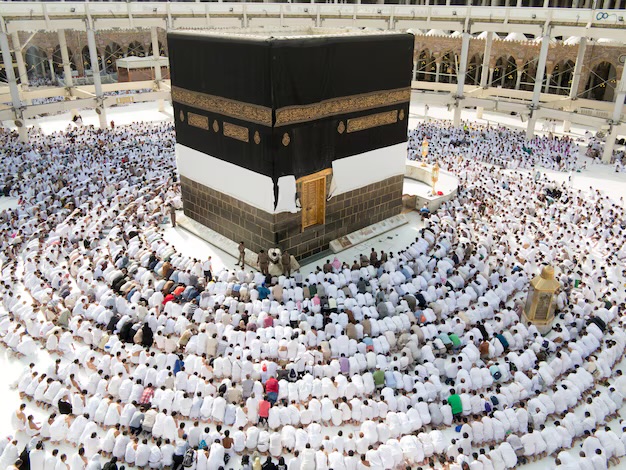
Seven circuits around the Kaaba, starting from the Black Stone.
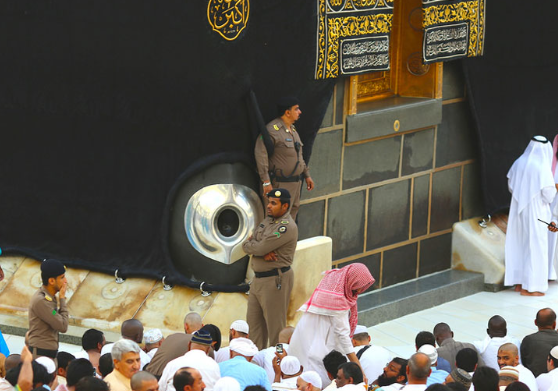
At the start of the tawaf:
بِسْمِ اللَّهِ وَاللَّهُ أَكْبَرُ
Bismillahi wallahu Akbar
"In the name of Allah, Allah is the Greatest"
To be repeated at the end of each of the 7 circuits, when facing the Black Stone, raising the right arm.
Rukn al-Yamani (the Yemeni corner)
It is a Sunnah to recite the following dua between Rukn al-Yamani (the Yemeni corner) and Hajar al-Aswad (the Black Stone) :رَبَّنَا آتِنَا فِي الدُّنْيَا حَسَنَةً وَفِي الْآخِرَةِ حَسَنَةً وَقِنَا عَذَابَ النَّارِ ❁
Rabbana atina fid-dunya hasanatan wa fil-akhirati hasanatan wa qina adhaban-nar.
"Our Lord, grant us good in this world and good in the Hereafter, and protect us from the punishment of the Fire." [Surah Al-Baqarah, 2:201].
Salah
At the end of the tawaf, perform two rakahs of salah, preferably in a position where Maqam Ibrahim lies between you and the Kaaba.
Bear in mind, however, that Maqam Ibrahim stands inside the mataf, so pilgrims performing the tawaf often have nowhere to move
except around and almost over those praying just on the other side of Maqam Ibrahim, which causes great congestion.
If the prayer cannot be performed there because of the crowds, it may be performed anywhere in Masjid al-Haram.
It is Sunnah to recite Surah Al-Kafirun (surah 109) in the first rakah and Surah Al-Ikhlas (surah 112) in the second, after Surah Al-Fatiha. Be sure to make plenty of dua after performing the prayer.
Drinking Zamzam water
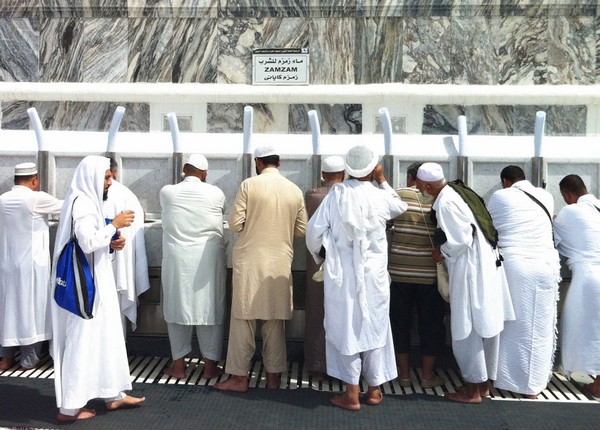
After performing the salah and making dua, drink the Zamzam water available around the tawaf area and at various fountains and dispensers in Masjid al-Haram.
You may recite the following dua after drinking the water:
اَللَّهُمَّ إِنِّي أَسْأَلُكَ عِلْمًا نَافِعًا وَ رِزْقًا وَاسِعًا وَ شِفَاءً مِنْ كُلِّ دَاءٍ ❁
Allahumma inni as'aluka ilman nafi'an, wa rizqan wasi'an, wa amalan mutaqabbalan, wa shifa'an min kulli da'.
"O Allah, I ask You for beneficial knowledge, abundant provision and healing from every illness."
The Sa'i
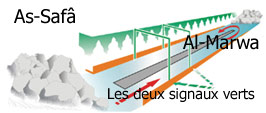
Seven trips between Safa and Marwah. The start is from Mount Safa, and since there are seven trips, the Sa'i ends at Mount Marwah.
Men should quicken their pace between the two green lights in the ceiling.
On reaching the mound of As-Safa
At Safa, the Sunnah is to recite the following:
"Innas-safa wal-marwata min sha'a'irillah,
faman hajjal-bayta awi'tamara fala junaha alayhi an yattawwafa bihima,
wa man tatawwa'a khayran fa innallaha shakirun alim"
"Indeed, Safa and Marwah are among the symbols of Allah. So whoever makes Hajj to the House or performs Umrah does no wrong in going between them.
And whoever volunteers good, then indeed Allah is Appreciative and All-Knowing." [Surah Al-Baqarah, verse 158]
إِنَّ الصَّفَا وَالْمَرْوَةَ مِن شَعَائِرِ اللَّهِ فَمَنْ حَجَّ الْبَيْتَ أَوِ اعْتَمَرَ فَلَا جُنَاحَ عَلَيْهِ أَن يَطَّوَّفَ بِهِمَا ۚ وَمَن تَطَوَّعَ خَيْرًا فَإِنَّ اللَّهَ شَاكِرٌ عَلِيمٌ
On Safa and Marwah, facing the Kaaba
It is customary to recite the following duas:
"Allahu akbar, Allahu akbar, Allahu akbar wa lillahil-hamd.
Allahu akbar ala ma hadana wal-hamdu lillahi ala ma awlana.
La ilaha illallahu wahdahu la sharika lah, lahul-mulku wa lahul-hamdu wa huwa ala kulli shay'in qadir."
Allah is the Greatest. Allah is the Greatest. Allah is the Greatest.
To Allah belongs all praise.
Allah is the Greatest for having guided us, and praise be to Allah for the care He has shown us.
There is no deity but Allah alone, with no partner. To Him belongs sovereignty and to Him belongs praise, and He is able to do all things.
للهُ أكْبَرُ، اللهُ أَكْبَرُ، اللهُ أكْبَرُ، وَلِلَّهِ الْحَمْدُ، اللهُ أَكْبَرُعَلَى مَا هَدَانَاََ وَالْحَمْدُ لِلَّهِ عَلَى مَا أَوْلَانَا. لَا إِلَهَ إِلَّا اللهُ وَحْدَهُ لَا شَرِيكَ لَهُ، لَهُ الْمُلْكُ وَلَهُ الْحَمْدُ وَهُوَ عَلَى كُلِّ شَيْءٍ قَدِيرٌ
Shortening the hair
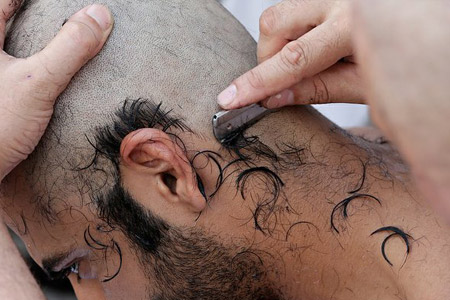
The last step in leaving the state of ihram
Final supplication:
اللَّهُمَّ تَقَبَّلْ مِنِّي
Allahumma taqabbal minni
"O Allah, accept this from me"
A man must either shave his head completely or shorten his hair.
A woman need only cut the length of a fingertip (one joint of a finger), that is about 2.5 centimetres from the ends of her hair.
Important reminders:
- Keep your intention pure throughout the rites
- Follow the order of the stages
- Avoid what is forbidden in ihram until the rites are complete
- Make plenty of personal supplication during the tawaf and the sa'i