Get the Muslim Alim app
Hijab in Islam: what the Quran says, its conditions and meaning
The hijab is the veil a Muslim woman wears to cover her hair and body in front of unrelated men, out of obedience to Allah.

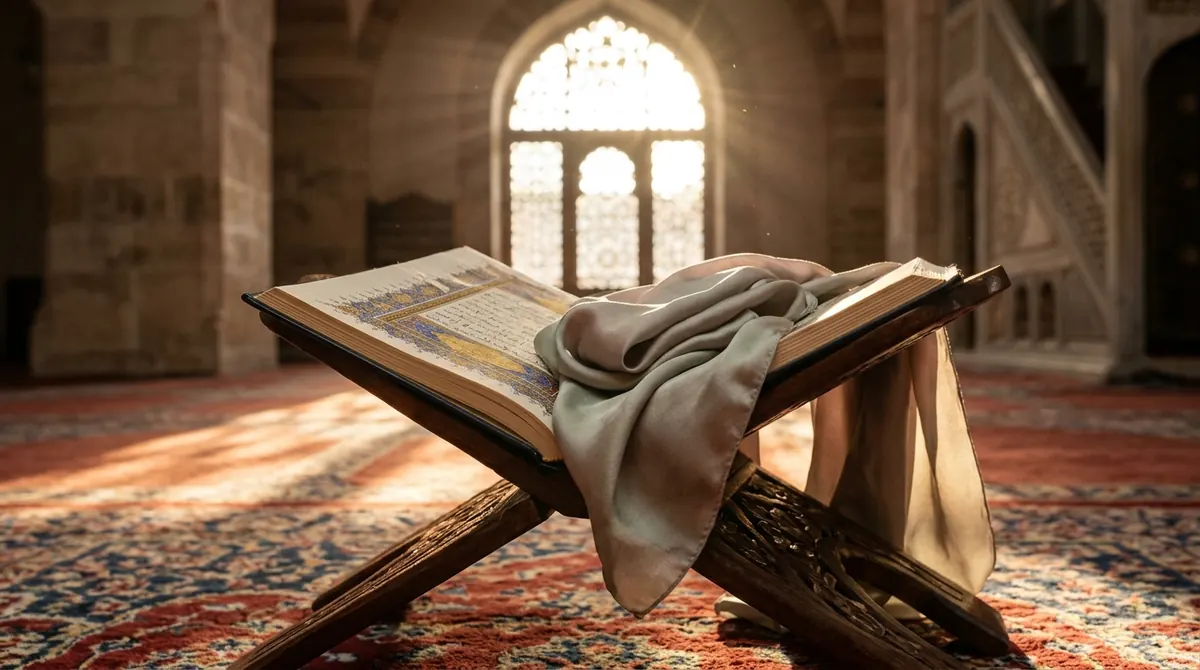
The hijab in the Quran
“And let them draw their head-coverings (khimar) over their chests.”
Surah An-Nur, 24:31Verse 31 of Surah An-Nur begins by asking believing women to lower their gaze and guard their chastity, right after addressing the same request to believing men (24:30). The khimar was the veil covering the head: it is asked to be drawn over the chest.
Surah Al-Ahzab adds: “O Prophet! Tell your wives, your daughters and the believing women to draw their outer garments (jilbab) over themselves: that is more suitable so that they will be recognised and not be harmed” (33:59).
The conditions of the Muslim woman’s dress
- Cover the body, except the face and hands according to most scholars.
- Be loose, without showing the shape of the body.
- Be thick, not transparent.
- Not be an adornment that attracts attention.
- Not be perfumed when going out in front of unrelated men.
- Not imitate men’s clothing.
The meaning of the hijab
The hijab is not just a piece of cloth. It expresses modesty (haya), which the Prophet ﷺ said is part of faith (Sahih al-Bukhari, 9). It reminds us that a person’s worth lies in their piety and character, not in their appearance. It is also one of the traits of the pious woman in Islam.
In front of whom a woman may remove her hijab
| People (mahrams) | Source |
|---|---|
| Husband, father, father-in-law | An-Nur, 24:31 |
| Sons, the husband’s sons | An-Nur, 24:31 |
| Brothers, sons of brothers and sisters | An-Nur, 24:31 |
| Women, young children | An-Nur, 24:31 |
To go further, read our pages on women in Islam and on wudu for women.
Continue reading
All of Islamic knowledge


You may be wondering…
Is the hijab obligatory in Islam?
For the great majority of scholars of the four schools of law, covering the hair in front of men outside the close family is an obligation for the adult Muslim woman. They rely on Surah An-Nur (24:31) and Surah Al-Ahzab (33:59). Wearing the hijab remains an act of worship that should come from sincere conviction.
At what age is the hijab worn?
The obligation begins at puberty, like prayer and fasting. Many families let girls get used to it earlier, without pressure, so that the veil is a choice lived with serenity.
What is the difference between hijab, niqab and jilbab?
The hijab covers the hair, neck and chest while leaving the face visible. The jilbab is a loose garment worn over clothes that covers the body. The niqab also covers the face, leaving the eyes: most scholars consider it recommended, not obligatory.
Can a woman remove her hijab in front of relatives?
Yes. Verse 24:31 lists the people in front of whom a woman may uncover: her husband, father, sons, brothers, nephews, women, children who are not yet aware of women’s privacy, and others. These are the mahrams.
Test your knowledge of Islam
3 questions, then as many rounds as you like.
Loading questions…